







Custom Scooter & Compatibility Buying Guide
How every part fits together, what to look for, and how to build a custom scooter that actually works — without ending up with parts that don't match.
Before you buy a single part
A custom scooter is only as good as how well its parts fit together.
A stunt scooter is made of a handful of key parts — deck, fork, bars, clamp, headset, wheels and brake — and they all have to speak the same language. Unlike a complete scooter, which is designed to fit together out of the box, a custom build is only as good as the choices you make. This guide walks you through what each part does, how to keep everything compatible, and how to size and spec a scooter around the way you ride. When in doubt, our workshop crew are riders too — bring your setup in or give us a call and we'll check it with you.
A complete arrives pre-built and balanced by the manufacturer — better value part-for-part, no compatibility guesswork, and ideal for beginners or a first scooter. You can still upgrade it over time as you progress.
A custom build lets you hand-pick every part to suit your size, style and budget. It's the way to a truly personal setup, but you're responsible for getting the parts to match. If it's your first scooter, start with a complete and customise later; if you know what you want, a custom is hard to beat.
Don't want to spec every part yourself? See the Prebuilt Customs tab above — we've already put a range of compatibility-checked custom builds together for you.
Your style shapes almost every part choice, so it's worth deciding first:
- Park — smooth ramps and transitions reward a lighter, nimbler setup: narrower deck, lighter bars, slightly softer wheels for grip.
- Street — ledges, rails and rough ground reward durability: a wider, tougher deck, stronger bars, and harder wheels that resist flat-spotting.
- Both / all-round — a mid-width deck and balanced parts will handle a bit of everything as you find your feet.
You won't need much: 5mm and 6mm allen keys cover most clamp, compression and axle bolts, and a 13mm spanner or socket handles the axles. A few zip ties help feed grips on, and grip tape needs a sharp blade (get an adult to help there). Always use the correct-size allen key — the wrong size rounds bolt heads and can mean a professional repair.
Already built, already compatible
Want everything above handled for you? We've done it already.
Everything on this page — compression, clamp, wheel clearance, sizing — is exactly what our workshop checks before any build leaves the shop. If you'd rather skip the part-by-part spec'ing and start from something already dialled in, we hand-assemble a range of custom scooters in-house using premium components from brands like Ethic, Apex and Unfair. You get the feel and performance of a genuine custom, without the compatibility guesswork.
Pandemonium
Built on the Ethic Pandemonium deck — light, reinforced, and dialled for street.
Shop the range →Apex 5" Wide
Apex's wider deck for extra stability — a planted, park-ready feel.
Shop the range →Unfair FX-1
Lightweight and durable — built to take a hit and keep riding.
Shop the range →Under $600
Genuine hand-built customs, priced to get you riding sooner.
Shop the range →Can't find your exact match?
Or tell us what you're after and we'll see what we can build.
View All SV CustomsThe anatomy of a scooter
What each part does, and what to look for when choosing one.
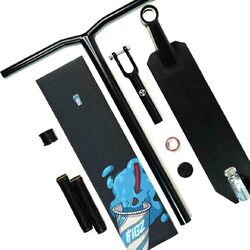
A build comes together from around eight parts. Here's what each one does and the things worth checking before you buy — the compatibility side is covered in depth on the next tab.
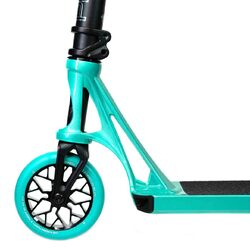
The platform you stand on, and the part that ties the fork, wheels and bars together. It has the biggest say in how a scooter feels.
What to look for: width and length (see the Sizing tab), the built-in headtube standard and angle (this dictates your headset and fork), the maximum wheel size it will clear, the brake mount, and the axle size. Wider decks give more stability and grind space; narrower decks are lighter and easier to spin.
Holds the front wheel and carries the compression system that connects your bars.
What to look for: the compression type it's built for (IHC, HIC or SCS), the maximum wheel diameter and width it will clear, and the axle standard. Your fork, bars and clamp all have to run the same compression system — this is the single most important match in the whole build.
What you steer with, and a huge factor in comfort and control.
What to look for: diameter (standard 31.8mm or oversized 34.9mm), whether they need a slit for your compression, height and width to suit you, material, and shape (T-bar vs Y/bat-wing). We've got a dedicated bars & compression guide if you want to go deeper.
Secures the bars to the fork and compression, keeping the front end tight.
What to look for: it must match your bar diameter (standard or oversized) and your compression. IHC and HIC setups generally use a two-bolt clamp; SCS uses a taller four-bolt clamp that combines the clamp and compression in one unit. More bolts generally means more clamping strength.
The sealed bearings that let your fork (and therefore your bars) spin smoothly inside the deck's headtube.
What to look for: whether your deck is integrated (bearings drop straight into the headtube — the modern standard) or non-integrated (needs pressed cups). Your headset has to match the deck's headtube and the fork's crown race. A threadless headset paired with a compression system is the setup we'd recommend for any serious rider.
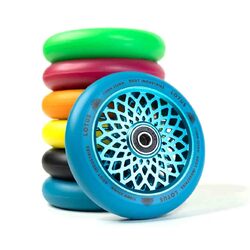
Diameter, width, core and urethane all change the ride. A solid metal core is essential for tricks — plastic cores are for absolute beginners only.
What to look for: diameter (100–125mm; most builds run 110mm, some run 120mm for a touch more speed), width (typically 24mm, up to 30mm), core material, and urethane hardness (durometer — see the Sizing tab). Crucially, both your fork and deck must have enough clearance for the size you choose.
Bearings sit inside the wheels and let them spin. Nearly all scooter wheels use the standard 608 bearing size, so they're one of the few near-universal parts.
What to look for: sealed bearings and a set of spacers. You'll see ABEC ratings quoted — treat them loosely, as they're not a great measure of real-world scooter performance; sealed quality and upkeep matter more. Check whether axle bolts and spacers are included with your wheels, fork or deck, as some parts include them and some don't.
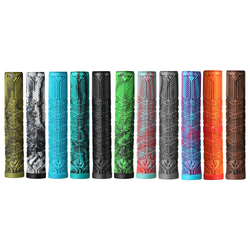
Brake: flex or bolt-on styles that must suit your deck mount and wheel size. Grips: nearly all fit standard 22.2mm bars, so length and feel are the main choices — and don't forget bar ends, which need to match your bar's inner diameter (and whether it's slit). Grip tape: pick a sheet that suits your deck width and trim to fit. Grips, tape and wheels are the parts you'll replace most often, so they're an easy, cheap way to refresh the feel.
Making everything fit together
The checks that stop you buying parts that don't match.
Scooter parts are made to different standards, so not everything fits everything. The good news: almost every compatibility question comes down to a few things. Get these right and the rest follows. Compression is the linchpin — it ties your fork, bars and clamp together — so decide that first, then work outwards.
- Compression system — IHC, HIC or SCS. Your fork, bars and clamp must all be built for the same one.
- Bar diameter — standard (31.8mm) or oversized (34.9mm). Sets which clamp you need.
- Wheel size — diameter and width, which both your fork and deck must clear.
- Deck standards — headtube type, max wheel size, brake mount and axle size.
- Fork — compression type plus its maximum wheel size and axle standard.
- Clamp — matched to bar diameter and compression, with the right bolt count.
Compatibility cheat sheet
What each part has to match, and what to check on the spec.
| Part | Must match with | What to check |
|---|---|---|
| Bars | Compression + clamp | Diameter (standard / oversized) and compression compatibility |
| Fork | Compression + wheels | Fork type (IHC / HIC / SCS) and max wheel size supported |
| Clamp | Bar diameter + compression | Standard (31.8mm) vs oversized (34.9mm), and bolt count |
| Wheels | Fork + deck clearance | Diameter (110 / 120mm) and width the fork and deck allow |
| Deck | Wheels + brake + fork | Max wheel size, headtube standard, brake mount, axle size |
| Headset | Deck headtube + fork | Integrated vs non-integrated; matches fork crown race |
Common compatibility mistakes
The traps we see most often — easy to avoid once you know them.
IHC forks are built for standard 31.8mm bars. Oversized bars won't fit unless you use the correct conversion shim. Match the bar diameter to your compression before you buy.
Not every fork and deck clears 120mm (or wider) wheels. Always check the maximum wheel size for both the fork and the deck before upgrading — a wheel that rubs is a wheel you can't ride.
A standard clamp won't close around oversized bars, and an oversized clamp won't grip standard bars properly. Match the clamp to your bar diameter and compression every time.
An example of a setup that works
One combination where every part speaks the same language.
| Compression | HIC |
| Fork | HIC fork, rated to 120mm wheels |
| Bars | Oversized (34.9mm), with a slit |
| Clamp | Oversized, two-bolt |
| Wheels | 110mm × 24mm (within fork and deck clearance) |
| Deck | Integrated headtube, rated to 110mm+ wheels |
Getting the size right
Arguably the most important thing to nail — comfort, control and safety all follow it.
On a complete scooter, everything is proportioned for you, so you only need to match the bar height to the rider. On a custom build, the two sizes that matter most are the deck and the bars. Get these right and the scooter will feel like an extension of you; get them wrong and every trick is harder than it needs to be.
Deck size
Width matters more than length — it comes down to foot size and style.
| Deck width | Best for | Feel |
|---|---|---|
| Narrow (≈ 4.5"– 5") | Younger riders, smaller feet, park | Lighter and nimbler — easier to spin and whip |
| Mid (≈ 5"– 6") | All-round riding | A balance of stability and manoeuvrability |
| Wide (≈ 6"+) | Bigger feet, street, grinding | More stable platform for landing and grinding |
Bar height & width
The golden rule for a scooter that fits.
As a starting point, bar height should land somewhere between your mid-thigh and just below the belly button when you're standing on the deck — around waistline height is the general sweet spot. Taller bars give more leverage and control; shorter bars can feel snappier for spins. Width is mostly preference, but roughly shoulder width is a comfortable default. Measuring your current bars is the easiest reference point — and if a bar is too tall, we can cut it down to size before we dispatch it. Unsure? Our scooter size guide can help.
Wheel size & hardness
Speed, grip and durability all live here.
| Choice | Softer / smaller | Harder / bigger |
|---|---|---|
| Diameter | 100–110mm — lighter, snappier | 115–125mm — faster, more roll |
| Durometer (hardness) | ≈ 86A — more grip, best on smooth park | ≈ 87–88A — harder-wearing for rough street |
Materials & weight
Every gram saved is usually a trade against strength.
Lighter parts are easier to flick and spin, but as a rule the lighter a part is, the more easily it can break. The best build balances weight against how hard you ride — a heavier street setup will shrug off abuse, while a featherweight park setup rewards a smoother rider. Here's how the common materials stack up.
Bar materials at a glance
The most common trade-off you'll weigh up.
| Material | Weight | Strength | Notes |
|---|---|---|---|
| Alloy / steel (chromoly) | Heaviest | Strongest | Cheapest; a street favourite. Standard or oversized diameters. |
| Aluminium | Lighter | Good | Popular for park. Standard ID / oversize OD; not HIC-compatible. |
| Titanium | Lightest | Strong | Premium price. Oversized; suits SCS (and HIC/IHC with a clamp/shim). |
Most quality decks are aluminium — often 6061 or the stronger 7075 alloy, and either extruded, forged or CNC-machined. Lighter, box-shaped or heavily machined decks save weight; heavier, solid decks take more punishment. Forks are usually aluminium (light) or steel (tough) — street riders often lean steel for durability, park riders lean aluminium for weight.
A metal (alloy) core is essential for tricks — plastic cores flex and break under impact and are fine only for the youngest beginners. Full/solid cores are the strongest; hollow and spoked cores shave weight. The urethane around the core is what you tune with durometer: softer for grip, harder for wear (see the Sizing tab).
Before you check out
Want us to check your build?
Send us your part list before you buy, or bring your scooter into our Coopers Plains workshop — call (07) 3172 1840 and our crew will make sure everything fits.
Ask the team